Wednesday, August 28, 2013

Catholic Alternatives for Trial and Triumph

One of the more interesting texts that Ambleside Online uses in its Primary school years, is the Religious biography book Trial and Triumph, and the book Saints and Heroes (in two volumes) as an alternative in later years.


The books are not particularly Catholic friendly, not just because of their choice of heroes in the Post reformation years, but also because of their handling of doctrinal issues.
This doesn't necessarily make the books bad as such, just not really in line with Catholic teachings!

Enter the alternative.  Actually, there are a few options for Catholics out there, but they are not exactly like the books they will be replacing, so it is worth remembering that.

Throughout years 1-6, Trial and Triumph is used to provide historically pertinent biographical sketches of figures in Church history.  This makes the choice of books a little tricky, but Michele at Mater Amabilis has given it a great shot and has come up with some lovely choices!
Quickly distilled down, each of the early years uses an option for New testament, Catechism, Saint's Biographies and one for each of the main Church 'special' periods (Advent, Christmas, Lent and Easter).
You can read about those for each of the levels on the page in question.  We're concerned with the New Testament options, so those are the only ones I am going to mention.

Year 1: (Mater Amabilis Level 1B) has the child reading a picture Bible.  Familiarity with Biblical stories is always good :)

Years 2 and 3: (Mater Amabilis Level 1A) has The Life of Our Lord for Children by Marigold Hunt.

Years 4 and 5: (Mater Amabilis Level 2) uses The First Christians: The Acts of the Apostles for Children by Marigold Hunt for year one and Pearls of Peace - A Rosary Journey through the Holy Land by Christine Haapala for year 2.

Years 6 and 7: (Mater Amabilis Level 3) Has the children reading through the Gospels and a Bible History, and reading chapter book biographies of the saints.  The same goes for year 8 (Mater Amabilis Level 4).
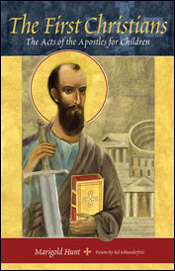


The two Marigold Hunt books for years 2-5 are the ones that I find quite thrilling.  Primarily because they are very good alternatives for Trial and Triumph.  If you also use A History of the Church: From the day of Pentecost Until the Council of Chalcedon A.D. 29 - A.D. 451 by John Mason Neale (not Catholic, but compatible) you have a very nice coverage of the Early Church.  The only downside, is that none of the books are particularly long, nor do they cover much time between Christ and His Apostles.  However, paired with the saint biographies (age appropriate) for each year, you get a fairly good coverage.  From year 6, the biographies are chapter books, which does allow for reading the eras you are covering in history especially those later, post reformation years.

What about older children?  An alternative to George Hodges' Saints and Heroes?
I noticed several that might be worth looking into (some were suggested by Andrew Campbell in the Latin Centered Curriculum)
The Fathers of the Church: An Introduction to the First Christian Teachers by Michael J. Aquilina Church Fathers: From Clement of Rome to Augustine by Pope Benedict XVI
Holy Men and Women Of the Middle Ages and Beyond by Pope Benedict XVI  
There are in fact, a number of books by Pope Benedict XVI that are worthwhile taking a look at!
In addition to each of these, there are of course, the works that the Church Fathers wrote themselves so definitely allow them to read those!

So, what should we use to replace Trial and Triumph?  For the earlier years, our own saint biographies and histories are quite good, but the later years chapter books and Primary texts are best.
There is no ONE alternative for Trial and Triumph, but instead a set of books.


Monday, April 15, 2013

The Young Folk's Treasury

Some years ago, I discovered a book called The Mother's Book, and blogged about it and the books that it recommended.

Coming across something which reminded me of it, I realised that I had come across the books online and thought that it was high time I linked them all :)  You can find my later collection titles at the original post linked above, and you can also find the same books listed as the "After school Library".

The Mother's Book

The Young Folk's Treasury
Volume 1 - Childhood's Favorites and Fairy Stories
Volume 2 - Myths and Legendary Heroes
Volume 3 - Classic Tales and Old Fashioned Stories
Volume 4 - Modern Tales and Animal Stories (can't find this one, if you do, let me know!)
Volume 5 - The Animal World
Volume 6 - Famous Travels and Adventures
Volume 7 - Heroes and Patriots (although I cannot find this, you might try this link, also by Hamilton Wright Mabie)
Volume 8 - Wonders of Science and Invention
Volume 9 - Men and Women of Achievement, Self Help
Volume 10 - Ideal Home Life
Volume 11 - Golden Hours With The Poets
Volume 12 - Music and Fine Arts

Wednesday, August 15, 2012

Back to School- Some Resources


So it is about that time of year, where everyone who homeschools is ready to start back at their work.
This usually coincides with the arrival of the new school supplies, and the mother's eagerness to start increases exponentially with the number of new books she has to try out!

Well, maybe that is a slight exaggeration, but if you have been there, I am sure you know the feeling!
That being said, I have a few things I want to share.  Partly for me, and partly for everyone else ;).


If you want to teach vocabulary to your kids, as a subject rather than as an incidentally taught thing, you might like these resources.

Free Rice (of course)
http://freerice.com/#/english-
vocabulary/10997

Vocabulary.com (apparently also has an iPad app)
http://www.vocabulary.com/

Wordly Wise (you can apparently do a lot online)
http://www.wordlywise3000.com/

SAT vocab tests
http://www.vocabtest.com/

and lots on Quizlet- which is a fabulous flashcard site.  You can see other people's sets, make your own and join groups.  There are several iPad apps that work with it too.
http://quizlet.com/207969/100-most-common-sat-words-flash-cards/

If you are a little leery of the rather expensive grammar programs out there, maybe you would like to have one of these vintage grammar books?


Emma Serl's Primary Language Lessons and Intermediate Language Lessons have long been popular amongst homeschoolers.  I also discovered this site with some workbooks for the former on it.
 
Sheldon has a bunch of grammar books for free online.  His Primary Language Lessons can be found here.

William Henry Maxwell has a whole series of grammar books.  These actually go through a composition course too.

1.  First Book in English
2.  Introductory Lessons in English Grammar.
3.  Advance Lessons in English Grammar.
4.  School Composition
5.  Writing in English.

In fact there are also speech books and other grammars too... it is well worth trawling through his works on Google books or Google play :) (Google Play also has an iPad app).
Mary Frances Hyde has a number of them too.
Practical Lessons in the Use of English (Part I)
Practical Lessons in the Use of English (Part 2)

So, if you are interested in other grammars or vintage books available, you can check out these two threads from The Well Trained Mind Forums.  Vintage GrammarsVintage Books.


Other favourites of ours are the McGuffey Readers and the McGuffey Speller.
Eclectic Primer
First Eclectic Reader
Second Eclectic Reader
Third Eclectic Reader  (This one is a Google Play book, so I hope the link works for you :))
Fourth Eclectic Reader
Fifth Eclectic Reader
Sixth Eclectic Reader
Eclectic Spelling Book
(here is an outline of how one mother uses the McGuffey spelling book).

Between these resources, you can find yourself with a pretty amazing course of language arts!

(all the images on this page come from the books mentioned here).
I have mentioned several iPad apps, because I have first hand knowledge of them.  There are probably Android apps too, and maybe a Nook or Kindle app or two, I just don't know anything about them :)

Tuesday, April 10, 2012

A Peter Rabbit Study


I decided once again to do a Beatrix Potter/Peter Rabbit Study.  I have had a little help- from these three sites, and I have adapted them for a slightly different crowd.
Homeschool Share Unit Study:
This is a nice, fairly comprehensive study using the Potter books.  I would venture that you would work from topic to topic, using the recommended books, and each topic (i.e. rabbits/mice) would take approximately a week to do.  The age range is diverse, about 2nd grade and up.
Elizabeth Foss' Unit Study:
This study is aimed at a much younger audience, with a few things thrown in for the older students.  I would say the age range is Pre-K through about 3rd or 4th grade.
Nevertheless, it is a lovely study, well scripted.  It needs a few adjustments as it is not in a final format and you will have to adapt the reading suggestions to your own family.
Mary's Potter Study Links:
Mary has not really made a study you can follow here, but she has shared a wealth of links that are truly very useful.  Worth the browse :)

So, now my adaptation.

Week 1:  Peter.


Books:
My Dear Noel - The Story of a Letter From Beatrix Potter by Jane Johnson
The Tale of Peter Rabbit by Beatrix Potter
The Tale of Benjamin Bunny by Beatrix Potter
The Tale of the Flopsy Bunnies by Beatrix Potter
The Tale of Mr. Tod by Beatrix Potter
The Story of a Fierce Bad Rabbit by Beatrix Potter

Read Aloud: The Fairy Caravan by Beatrix Potter

Biography: The Country Artist by David R. Collins and Nothing is Impossible by Dorothy Aldis

Mama Craft: making Tams like Benjamin Bunny's tam stolen from Mr. McGregor's garden.

Teatime: Currant buns.  Try this hot cross bun recipe, just leave off the cross :)

History: mark the main events of Beatrix's life on a timeline.  Add in the publishing dates of each book as you read it.

Art: Read one of the biographies for Artist study.  And then for picture study, choose a favourite picture from Peter Rabbit and work with it.
Play with watercolours for an art project.

Language Arts: the homeschool share unit has a few language arts suggestions, either use these or Primary Language Lessons which can be found in Google Books.
Have your child read from your selected reader each day, or alternatively, alternate readings from one of the Beatrix Potter books with your child.
Elizabeth Foss suggests William Blake's the Lamb as this week's poetry selection.  Walter de la Mare and Christina Rossetti are also contemporary poet's of Beatrix Potter's that you might enjoy reading instead.

Science: the homeschool share unit has a few science things relating to rabbits.  Try to meet some in person- either at a pet shop or with a friend who owns them if you don't have any of your own.

Nature Study:  Beatrix is well known for taking walks around the countryside near her home- and she painted it often.  Why not do the same for your garden or local area you walk in.

Gardening: it is not too late to plant some salad vegetables.  The homeschool share unit has some good vegetable related activities.

Geography: Working with maps, mark the areas in which Beatrix lived or stayed.  Look at the book Beatrix Potter's Lakeland for lovely visuals.  Google maps the area in which she lived.

Extras: watch the video versions of the Beatrix Potter books- your local library will probably have them.
Take a look through this site which is well worth looking at :)

More later!

Tuesday, March 6, 2012

In Praise of the Old

So, having worked our way through half of 'The Ordinary Parent's Guide to Teaching Reading' (OPG), my 8 year old was getting bored.   She hated the stories, and reading was becoming very much the chore.
The problem with that, is that I am trying desperately to teach her that she should LOVE to read.  How can I teach that if the very book I am teaching her to read with doesn't help?


For a little while I had tried "Teach Your Child to Read in 100 Easy Lessons" (100 EZ).  She liked it better, but I found that she was developing some bad habits reading wise (she is, I believe, very slightly dyslexic) and I switched back.
And then I found the McGuffey readers were all online now- for free.  I downloaded a copy onto my new Christmas iPad, and started working through it with her.
What a refreshing change!  Suddenly she is EAGER to read the stories.  The old fashioned pictures capture her imagination and can be used to actually entice her to read.  Vocabulary is built into it, and it even teaches her to read script!


The cute fuzzy animals that frequently appear in the pictures help too ;)

Now, I should state that I find that both the other books I mentioned are fabulous reading books.  They have definitely helped us learn the letters, and different letter blends too.  In fact, I would think you could easily use OPG as a way to learn some of the letter blends as they appear in the McGuffey readers.  It is just that, for a child who finds reading a little difficult, or is a lot harder to motivate and make them WANT to read, a book like this is a gem.
Once we have her cursive writing lessons finished, she will end up copying the script sections in the readers too.

This is the picture that convinced her to read today. 
You can see the script here.


There is also a High School reader.  I think I shall work with my son through the readers too.  He has a few bad reading habits that need to be broken!

Speaking of my 12 year old, I have a few words in praise of the old for him too.  I have found that he positively loves the classics.  He has been reading through Anne of Green Gables, and before that worked through Tom Sawyer.  I cannot say he is the fast reader I am.  In fact he is an easily distracted reader (unless it is a book that is totally unrelated to school, in which case he is FAST and cannot be distracted from reading).  But he has discovered a love for the classics.  The giggles and chuckles heard from his corner when reading the Hobbit (although I really wish he had not learned some of the sayings in there- we have had an outbreak of 'Shut yer gob' ever since!) or Oliver Twist are a balm to a mother's heart.  I have all kinds of other stories lined up for him.  If he would just READ faster!


If you are interested in reading with classics or Old Fashioned books, you might enjoy these links.  I am not affiliated with any of them, neither do I control what you will find there- so be warned ;)

For a complete set of the McGuffey Books, hardbound and with a teacher's guide by Ruth Beechick, you can go to Mott Media and get them.

An Old Fashioned Education has some really good resources.  You can pretty much homeschool for free there :)


The Baldwin Online Children'sLiterature Project is a huge selection of wonderful old books that have been transcribed and put online for free.  You can also buy them from the site in real book and ebook format :)

Project Gutenberg is the best free ebook site online- you can get all the classics and public domain texts you want here.

Sacred Texts have some good free ebooks.  They also have a nice selection of Fairy Tales.

The Internet Archive has a huge selection of books to choose from.

Ambleside, of course, has a library of books and links to their choices online.

There are lots of free scanned books at Google Books online too.

Now, when it comes down to it, you can do several things with the books.  I prefer to download the Pdf format and read it on my iPad with my daughter- so she can see the pictures.
Otherwise I download the kindle or epub formats.  The former I can read on my iPad, the latter I can read on the iPad or the Nook (so it is my preferred format because I use it with my son).
If you like, you can also print out and bind it separately.

Tuesday, May 3, 2011

Some Charlotte Mason Resources

I thought that I might do a couple of blog posts where I share some of my favourite resources.  This one is all about Charlotte Mason related things.

Ambleside Online
This is a comprehensive (and wonderful) set of links- the CM books, a whole curriculum and lots of resources written by CM fans!
Mater Amabilis
A Catholic CM course.
Handbook of Nature Study
A Nature study blog- fantastic resource and well worth following.
Simply Charlotte Mason
A site with lots of CM related resources AND a curriculum and planner.  Worth looking at.
Reading Your Way Through History
A CM style living history curriculum
Secular CM
a secular Cm site.
MacBeth's Opinion
Lots of book suggestions for living books.
Charlotte Mason Help
Lots of useful links.
Charlotte Mason Education
Catherine Levison's site
Penny Gardner
Penny Gardner's Site.


Books
The Original Homeschooling Series by Charlotte Mason
A Charlotte Mason Companion by Karen Andreola
A Charlotte Mason Education by Catherine Levison
More Charlotte Mason Education by Catherine Levison
When Children Love to Learn edited by Elaine Cooper
A Charlotte Mason Study Guide by Penny Gardner

Blogs
There are SO many blogs out there that I will surely forget some.  Instead I shall link you to a thoughtful mother's Squidoo about CM blogs.
And of course you should check out my sidebar links- one day I might make a CM section too ;)
And some others you might enjoy:
Ambling with Charlotte
Distinctly Different
Golden Acorn Homeschool
The Science of Relations
Charlotte Mason and Home Education

Groups
Ambleside Online
There are MANY subsidiary groups for AO, but if you like Ambleside, you should join this group and any others that apply to you :)
Living Math
Catholic CM
Cmason

Tuesday, January 4, 2011

Nose back to the Grindstone

After spending so little time on school since our October visit to England, we are back to the grindstone.  Only with changes.
As each new year arrives, I consider it time to evaluate what we are doing as a homeschool, and make any necessary changes.   I know I am not alone!

Today, however, marked some biggies.
First off, I made a strict schedule for Rebel.  This covers his entire waking life, from getting up to going to bed.  I have a feeling it is necessary, because he is one that thrives off of such routines.  M'Lady doesn't have such a schedule (yet) because she is not so needful of it, although I would venture to say she likes it just as well as he does.

I also ditched the creative writing curriculum we were using.  Although I love Classical Writing and think it is a great curriculum, this is one of those instances where the child in question just did not do well with it at all.  I am pretty sure most of his issues are sheer laziness.  But be that as it may, it doesn't mean that it is the right one for us.  Instead, I will eventually start him on something else.  I am hoping to use the Institute for Excellence in Writing's Teaching Writing: Structure and Style.  I think it will be an interesting change.

I am thinking of putting a time limit on how long each lesson takes.  Yes, this comes after a 4 hour mathematics lesson....

Rebel is not the only one who had some changes made.  M'Lady had her reading book switched around.  Many years ago I bought Teach Your Child to Read in 100 Easy Lessons for Rebel.  It bombed big time with him and I set it back on the shelf and used The Ordinary Parent's Guide to Teaching Reading instead.  This time I started with Ordinary Parent's Guide... M'Lady was forever complaining that it was too boring/too hard or something else...  Today I decided to switch to 100 Easy Lessons.  And it worked.  She definitely preferred the structure of that lesson to the OPG.  Apparently the kids are polar opposites.

The biggest change though, would be something fun.   You can see it here in the picture I took just in case there was a yarn along last week (there was not).


See that there?  The thing on top of the book?  THAT is a Nook Color.  My Christmas present and new e-reader.  Oh how I love that thing. 
I discovered, quite luckily, how to put Project Gutenberg e-books on it.  There are two ways- you can download to your Nook, or you can download to your hard drive and import it into your Nook Library.
So why did it make it into this post?  BECAUSE it is the perfect homeschool tool.  Not only can you quietly browse the web/email etc. while schooling, but you can also use it for the numerous e-texts you might use say, in the Ambleside Online curriculum.
We actually use several e-texts, and I am grateful to have a readable screen and less to print... plus it is a pretty good motivator for reading :)  In fact Rebel, read the entire history chapter I set for him today- so well, that he picked up on something the author left out of the story (namely WHAT Cardinal Wolsey had predicted).  I am satisfied that he read the text today ;)

Wednesday, December 1, 2010

Advent with Children

The kids got to open their advent calendar today :)


I made the advent pockets a few years ago...

Sorry about the image quality- it is dark and rainy here today.  Not much in the way of good lighting ;)
Inside the pocket...


... were goodies.  I picked up these chocolates from England while I was there.  They are GOOD ;)


AND they are cute too :)


After that, hanging the tag seems a little... well... anticlimatic I guess :)  Never mind -the kids didn't seem to!

Friday, August 13, 2010

Music in Classical Education

Music is one of those subjects that is, rather unfortunately, overlooked by most people.  It formed a large part of life in previous centuries, and was given a very honourable place by the ancients- and more.  In fact, Thomas Jefferson himself placed a great deal of import on the learning of music, forcing his children to practise for hours each day.

So how can we incorporate music into our modern homeschools?
We should have very little difficulty, after all, we are blessed with the most amazing capabilities to reproduce and listen to music any time we feel like it.  In fact, as I type this, my computer is also playing a selection of music. 
So find below an adequate outline of study, designed along the lines of a classical education!
(I shouldn't hesitate to say that yes, music was part of the quadrivium of studies, BUT I suspect that in that case it was very much the compositional and performance arts that were practised, the foundational blocks having been laid long before).

Music Theory:
All music study should begin with the basics of music theory.  a quick trip to the local music stores will supply you with a multitude of books you can follow along with if you absolutely must :)
Children should be familiar with written music and the application of it to an instrument.  There is no reason it has to be a complicated instrument like a guitar, violin or piano (although any child who expressed the desire to learn should not be held back from this either)- a simple recorder is more than sufficient.  In fact, the recorder can be a very pleasing instrument to learn, since it is quickly mastered.

www.8notes.com has a wonderful selection of music theory lessons.  In fact, I thought it very well done and highly recommend it.  If you are not American, then there is a good possibility that your own nomenclature may differ- I know I learned all the English note names when I learned to read music, and my mind does not readily translate to the American terms.  That being said, I really think there is no real issue with learning the names of a different country unless you are planning to follow through with some kind of examination process (such as the grade music system in England).  I have been told by other sources, that getting the music 'grades' in England is not absolutely necessary if you follow the performance circuit instead, but that involves having a super teacher who knows how!  (My sister is currently doing this so I can probably get more information should you need it- just email me ;))
8notes also has a selection of composer biographies and some sheet music.
As a memory aid, you can use the flashcards at Linkware Graphics to learn the note names and some other common musical notations.

Music theory of course, would not be complete without learning a little about each of the eras of music.  There is a nice, and somewhat simple, timeline you can view here at Dr. Estrella's Abridged Dictionary of Composers.  It is by no means a comprehensive one, but it has a great outline of the dates in question.

It seems to me that memorizing the eras might in fact be a good idea.  not to mention some of the terms used in studying music.  To that end I made up some flashcards to help with that :)  You fold them on the centre line and either glue together or laminate (or both).  All the information was found online.
You can drill these as a standard part of your memory work cycle.

Work your way chronologically through the musical eras reading up on the big name composers as you come to them.   There are a number of wonderful children's  books about the biggest names out there, or you could use the aforementioned 8notes site.


Ideally, you would trawl through the centuries, listening to the composers as you come to them, using the composer's work to illustrate the music definitions you are learning.
Here is a site with a nice overview of music history.  If I eventually find a great book to help your travel through the centuries (think as a spine) I'll keep you posted.

Wednesday, August 11, 2010

Back to School- with adjustments!

It's back to school time at our house.
Nothing special. Just a slow adjustment period to doing lessons. Sometimes while waiting for books to arrive.
Usually with the kids being rather reluctant to actually work.
I have had the plans set up now for a few weeks.
I find that I need to have everything planned out for accountability purposes- after all, if it is planned there on the page, I can hardly claim to not know what I need to do now, can I?
As with everything planned like that, it means that adjustments have to be made.
So I started with mathematics.  Daily mathematics is easy to instigate- especially since Rebel is using Teaching Textbooks.  He is using TT7- which is about 6th grade level, and has been since earlier this year.  This level is self-grading (what a great concept- I wish the future levels were too!!) and the program is geared towards the homeschooler.  It is well organized and features a great amount of in-depth instruction- well worth the money!
M'lady has to make do with Singapore Mathematics :)  Not that I dislike it, we have used it for years.  It is just not quite as exciting for her as TT is for him!
This week I added in the reading subjects.  And languages.  I wasn't going to add in the languages (Latin and Greek) just yet, but he insisted.  That's just fine with me ;)
Some of our reading is lacking- because, well the books are not yet here, or I have to get them from the library for now!  But this is the one area that already needs adjusting.
We have started reading The Autobiography of Benjamin Franklin.  It is an interesting read, Franklin was an entertaining writer.  But the language of Franklin's time is different, and it is a rather harder read than I had expected.  My 20 pages a week (20 pages in the e-reader that is) would seem to be something I cannot accomplish in one, 1-hour lesson.  So we'll be reading my issued amount across the week.
I have also planned something new for the year.
If you look on my front page, you will have noticed that on my Goodreads widget, I have just finished reading "The Core" by Leigh Bortins.  (If you are reading in a blog reader, it is on my main blog page).
One thing I really took away from this book, was the desire (even, should I say, need) to do some memory work.  I am still in the planning stages of this, but I think I might well follow Leigh's Classical Conversations progress.  I do not want to do the coop itself (although I can see many good reasons to do it), but I would like to take away some of the suggestions from it!  Thus the reason for the memory work.  I will also add in some Shakespeare and Art.  Yes, I have absolutely NO excuse for not doing more art with the kids!
Our biggest adjustment is moving into the kitchen to do the work.  I have for years allowed the kids to sit on the floor to work.  This year I have decided to stay in teh kitchen and be the old cliche homeschoolers working around the kitchen table.  It makes my kids focus more- and it stops them making too much of a mess in the kitchen and the living room :)

Any way I look at it, I still have some tweaking to do. Hopefully I'll be back later with some progress!!

Thursday, April 29, 2010

The Reluctant Reader

 When I first had my children, I could never have conceived of the idea that I would have a child who was not anxious to read.  I remember I could not wait to read, and as soon as I was able, I read everything I could!
I read Pride and Prejudice at the age of 8.  I did not really understand it, but I read it anyway!
So I was very surprised when my son turned out to be the most reluctant of readers.  I blame my husband.  He is not the most avid of readers, he does not care for fiction and my son both takes after him and likes to emulate him.
It is not that my son is not a good reader- he is a good reader.  He just doesn't like to read.  He'd far rather play while listening to an audio book.  I suspect he is typical of many boys- reading means they have to pause and refrain from doing something else... of course it is o.k. when it is his idea to read.  Which for my son, usually means in the middle of another lesson, or instead of cleaning his room, or instead of going to sleep...
So how can you encourage the reluctant reader?
In the beginning, I started with the graphic novel and comic books.  Tintin can encourage the most reluctant reader to want to read a book, and Asterix works really well for history :)  Marvel and DC comics are good (though you should pre-read them) and the newer Japanese Manga books can be great.  Those can cause a little confusion at first since they are often printed backwards, but they are a lot of fun.
Next I found his weakness.  Weaknesses are not something that my son cannot do, but rather something he was very interested in.  In his case it was Lego Blocks.  I found a book on Lego blocks and building with them that really encouraged him.
Then I discovered 'silly' books.  Silly books don't have to be 'twaddle' (although some definitely are), but they have to be books that appeal to the humour of a child.  In my son's case, this was the Horrible Histories, Horrible Geography and Horrible Science books.  Horrible Books always draw his attention because they are just plain 'interesting', and written to appeal- and he still likes to read them.
Stories of children having adventures appeal too.  The reluctant reader can relate to them.  My son liked The Magic Tree House books and later, as he grew older and kind of outgrew the Magic Treehouse, they were replaced by The Hardy Boys, The Famous Five and The Secret Seven.
The Magic Tree House books were wonderful, because they were so short he would finish a book in no time. For the older elementary grades, the Hardy Boys have interesting adventures, and the Famous Five and Secret Seven books are stories about children his age having adventures.  That is almost always guaranteed to appeal!  He is a third generation reader of the Famous Five by the way- both my Mum and I read them and loved them ;)
The most recent addition to his reportoire would be the Redwall books.  I read these as a child his age, and I knew he'd like them.  My husband had seen the show and thought he'd like them, so we were non-plussed when he refused point blank to read them.  I kept the book around and would make him read a little every so often, but he still complained.
Then struck the latest of my 'tricks'.  I suggested that perhaps by reading this book he'd be better read than a local child he is somewhat antagonistic towards- because surely they had not read it.  He was encouraged to start reading it.  Then he started to argue.  So his punishment was one more chapter each time he argued.  He stopped after 5 chapters were assigned, started furiously reading- and read 7 chapters.  He was pleased with himself for reading the extra chapters ("that'll show you Mummy") but had ended up hooked, so the next few days he was reading the book as often as he could sneak an extra chapter!  I don't particularly recommend this method unless it is strictly necessary!

Nowdays he is just as difficult to please.  He doesn't want to read the books assigned for literature (too boring/badly written) or history ("I'm not interested in reading about that").  His excuses are just that- excuses.  He is being lazy, and it is difficult to ascertain the point where laziness and true dislike meet.   A true dislike is something that needs to be addressed, so typically when he comes up with a complaint, I ask questions to see why he is not enjoying it. 
So recently he was complaining about a King Arthur book I had assigned for Literature.
"Why don't you like the book?" I asked, as he complained.  After all, it's Knights and Castles and battles- surely those appeal to a boy?  Not to mention even his Dad told him he didn't understand why he wouldn't read it.  (Dad is the ultimate authority here- anything Dad likes, Rebel usually likes it too).
"It's boring," he said.  "They do stupid things!"  I asked for clarification.  He could give me none, so I said that was obviously not the problem.
He then complained that the book was written like a comic book- a complaint I really didn't get because he loves comic books!  I assumed this meant that he just did not care for the style of writing.  So I switched to a different re-telling.   Apparently that suits him better- I chose to get an audio version or Howard Pyle's retelling, where the style of writing is somewhat archaic so I made him listen and read along with it (I used an e-text for this, apparently e-texts are popular with him).
Afterwards I asked him, "So what do you think of that version then?"
"It is better written and it is funnier too..." came the response. Success!

His similar complaint of a history book turned out to be sheer laziness.  In that instance I just got an audio version for him to read along with...  
That is another good reluctant reader trick.  Following along with a book helps them to focus and seems (to them) to be less work.  It also frees you up to work with another child ;)

In essence, the reality of dealing with a reluctant reader is persistence and determination.  You have to patiently figure out what your reluctant reader likes and tailor the reading to suit.  You have to wait and try different techniques, different books and work hard.
And you have to never fail to try and make your reluctant reader, a book lover.
My brother was once a reluctant reader.  I used to work so hard to encourage him to read different books (yes I started young LOL).  I wouldn't say he is a bibliophile like myself now- but he reads books of his own choosing and has things he enjoys reading... so perseverance works.  On brothers- and hopefully sons too!

Wednesday, April 28, 2010

A Homeschooling Tool...

I have noticed that, among the homeschool community, the iPod - particularly the iPod Touch (iTouch) is a popular and versatile tool. You will see it mentioned at Melissa Wiley's blog, and Elizabeth Foss's blog (check her 'on my iPod'), and Mary from Evlogia's blog...
One might be forgiven for thinking I have followed a crowd here- but it is not true. My iTouch predates most of theirs ;) I got my iTouch years ago- for myself. It had nothing to do with schooling. It had everything to do with the ability to check email without having to turn on my machine, and listen to Podcasts when cooking or cleaning.

Later I discovered how useful it was to give M'Lady audiobooks to listen to as she was drawing or colouring. She would sit beautifully still for them. Storynory became a family favourite then.
When I discovered Librivox, I knew the iTouch had been given a new life- you know audiobooks are a great way to entertain kids in the car? And if your husband prefers music, well the iTouch can become a lifesaver!
And then the are the educational apps- training for multiplication and other mathematical skills, science, reading... These 'games' can entertain children anywhere. Especially when you are waiting!

You can download e-books to the iTouch- although I have yet to find an app that allows me to upload .pdf e-books to read :/ This allows you to NOT have to buy every classic book you will use in schooling- no, you can download them to the Kindle app, or the B&N eReader App, or the Stanza app.

You can listen to language podcasts or religious podcasts or lectures from universities...

There are various art apps too... for painting and drawing on the iTouch.
The list goes on and on.

So I wondered... what would be my ideal selection of things to do on the iTouch?

1. I'd love to see some kind of mathematics program on there- you know, something like Teaching Textbooks- only for first graders. It would be awfully nice to have something like that!
2. The ability to see 'flash' things on there- I could then watch certain TV shows without interrupting or disturbing the kids- or they each other! I could also access most websites no problem then!
3. An app for downloading and reading pdf files. Something like an e-reader, but with the ability to see a few pictures :)
4. A print feature. Wouldn't it be nice to be able to print from an iTouch?

Of course, since iTouch is far from perfect, there are many things I could ask for to improve it, but I think we are in a new generation of 'electronic schooling' devices- and the iTouch is leading the fray... it will be interesting to see where this leads us!

Friday, April 9, 2010

Letters of Grace

For those who really loved the alphabet path over at Serendipity, you will be overjoyed to learn that Mary from Evlogia, Anna and Matushka Emily have produced an Orthodox Christian centered version called Letters of Grace.  Mary was one of the people who started Serendipity with Elizabeth Foss before life got in the way, and the Letters of Grace curriculum is beautiful.  Even better, it is written at several different ability levels- so even if your child is a little old for the Alphabet Path, she might not be too old to follow along with Letters of Grace!!

Please, go enjoy the hard work of these wonderful ladies!

Wednesday, March 31, 2010

Pardon My Dust

And any multiple posts that might appear. You can probably see (if you are at the site) that I am in the middle of redoing all my blogs- blogger activated a fairly nifty new template tool through their 'draft' blogger section, and I have been playing with it. You can see the results on all of my blogs- AND the results of my learning a lot about my photo-editing software :)

Wednesday, March 17, 2010

St. Patrick

I know a lot of you like to celebrate St. Patrick's day, so I made a colouring page (couldn't find one I liked online...)
If you would like to use it, you can get it here.

You can also see a smaller version of it below :)


In other news, perhaps you'd like some good links for St. Patrick?

Irish Recipes from author Susan Wittig Albert
Free StoryNory Story about St. Patrick.
Taste of Home Recipes

Monday, November 23, 2009

DNA and Science

Sometimes, life takes you (and the kids) off at a tangent. Most homeschoolers refer to them as 'rabbit trails' and delight in the love of learning it shows the kids enjoying!
Well we experienced a 'rabbit trail' recently.
It started with a Science Magazine- on the cover was a picture of a DNA model, built from Lego blocks. Considering Rebel's love of Lego, I showed him the article.
Next thing you know, he wants to build a Lego DNA helix- and we're off into DNA land :)

If you have lots of Lego Tecnic blocks, you'll be able to manage this mini DNA helix.
Perhaps you don't have the right parts? How about a paper model instead?
This article tells you how to do it- with paper chain like DNA models...
This is a whole activity sheet with a paper DNA model.
The Japanese are really into the whole making things out of paper- so paper DNA models are no different :)

There are many others out there too :) You might be thrilled to learn that K'nex has a DNA model you can build, and a few other sites have their own variants on that theme too...
and then there are the books. The wonderful 4 Real Community helped with suggestions- these are the ones I managed to find and read for myself :)

Have a Nice DNA by Fran Balkwill and Mic Rolph (2002) This book is not 'Young Earth' friendly, other books by the author may cover topics like stem cells and cloning, and the 4 Realers have warned against them.
Gregor Mendel: The Friar Who Grew Peas by Cheryl Bardoe Not strictly DNA, but all about genetics.
The Stuff of Life: A Graphic guide to genetics and DNA by Mark Schultz, illustrated by Zander and Kevin Cannon. This is a graphic novel style guide to DNA- it is incredibly detailed and well written BUT does discuss such things as cloning, stem cells and evolution, although I think the way it is handled is less controversial than many other books- I would not go so far as to say that it was using a Pro-Life viewpoint either- just a neutral one. :) It IS a young adult read, and so is best given to kids who have been taught 'the facts of life' since that features prominently in the book. The suggested reading at the end does include controversial books too. This is definitely a parental advisory book- read it for yourself first ;)

Do be careful what you find to read on DNA with the kids- there are so many different levels of reading, and so many different philosophical viewpoints.

Hope you find these links helpful!

Thursday, November 5, 2009

Next Step: SELF Education

Susan Wise Bauer has a wonderful article in the latest Memoria Press Catalogue- all about how we, as homeschooling parents, have a duty to keep educating ourselves, that we might always have the ability to answer the questions of our children.
And then there was this blog post. Between the two, I was even more convicted to start educating myself some more.
Then there was the talk with parents and siblings who are doing yet more degree courses (the distance learning options are better in the UK than they are here in the USA), and the sudden realisation today that because I read the ancient classics to the kids, I KNOW what some of the old classical music pieces out there were written about - and I knew that, for a homeschooling mother, education truly does become a passion :).

So in my sidebar, you will see some of my reading. I am not planning on putting in my relaxing novels. There are too many of those and too many of them would be objectionable to someone or other (different tastes for different people of course LOL) SO instead I am putting in the fun reads I *would* recommend to others, or books I think *might* be interesting to others, or books that I know others are reading and might want to discuss :) And then I have also added the self education stuff too - not sure I will do it quite like AO does (the thought of stretching How to Read a Book over several years does not thrill me LOL).

All my self-education I will tag as 'Motherculture', and I hope that many of you will consider joining me in the Odyssey of my mind ;)

Thursday, October 22, 2009

Tweaking Ambleside

I have long admired Ambleside Online's curriculum- considering it is free, and considering a vast majority of the books recommended are available online, it is a huge and very useful resource.
Mater Amabilis (a Catholic CM curriculum online) is likewise a lovely resource, free of charge, but so many of the books on it are hard to come by and usually NOT free, that I usually end up using Ambleside instead :/
So I have been working on making some tweaks to Ambleside to make it just a little more Catholic friendly.(

1. Ambleside uses the KJV of the bible, which really does show a lyrical command of the English language. You might choose to read the KJV with apocrypha, but you'll have to remember not all of the viewpoints of the KJV are conversant with Catholic Doctrine. Instead, use the Douay-Rheims version of the Bible, which is a 16th/17th century edition of the Bible, revised (for easier reading) by Bishop Challoner in the 18th century (although that does depend on the version you are reading ;)).

2. Ambleside recommends Trial and Triumph by Richard Hannula for the Church History aspect of Bible study. It is a well written book, that is true, but it is so blatantly anti-Catholic I can't stomach reading any of it to the kids- not even the early chapters! A judicious review of Trial and Triumph will show you that it is a series of small biographical stories of Saints and Martyrs throughout the eras of the church- right up until around the 16th century, when it becomes a listing of reformation characters and founders. For the Catholic, a series of Saintly biographies might be used in its place.

Since Trial and Triump (T&T) is used throughout the first 6 years of Ambleside, I think we have a great deal of leeway in our choices.

Option 1: We use a book of Saint Biographies, not unlike that of T&T, and a book like John Mason Neil's A History of the Church from the Day of Pentecost to the Council of Chalcedon.

Neil's book goes up to A.D. 451, so even though he was Anglican, it is still quite usable by Catholics (and Orthodox) alike :) There is a follow-up book, called Stories of Church History, which might be a good choice to follow on from the original- I have just never seen it OR the Table of Contents, so I cannot say. He does have two other children's books online at google books too :)

Two Beautiful Saint Biographies you might like to use: Saints Lives and Illuminations by Ruth Sanderson and More Saints Lives and Illuminations by Ruth Sanderson

Once Upon a Time Saints by Ethel Pochocki, More Once Upon a Time Saints by Ethel Pochocki and Around the Year Once upon a Time Saints by Ethel Pochocki

The Loyola Treasury of Saints: From the Time of Jesus to the Present Day by David Self (this is not strictly ALL saints, but might be worth getting anyway- it is probably the most like T&T a Catholic book will get).

Patron Saints by Eliza Allen Starr is available free online, and has 20 Saint biographies in it :)

Option 2: You might like to use individual saint biographies, including picture books and chapter books (according to age and preference).

Books by Tomie de Paola you might like to use – some correspond to the Saints below, some are interesting religious books others are religious fables:

Patrick, Patron Saint of Ireland – Saint Patrick, Francis, The Poor Man of Assisi – Saint Francis, The Lady of Guadalupe – Saint Juan Diego, The Holy Twins: Benedict and Scholastica – Saint Benedict (author Katherine Norris), Christopher, the holy giant picture book – Saint Christopher, Pascual and the Kitchen Angels – St. Pascual, Mary the Mother of Jesus, The Miracles of Jesus, The Parables of Jesus, The Legend of the Poinsettia, The Night of Las Posadas.


Books by other authors you might like to use:

Mother Teresa by Demi, The Legend of Saint Nicholas by Demi

St. George and the Dragon by Margaret Hodges, St. Jerome and the Lion by Margaret Hodges, The Legend of Saint Christopher by Margaret Hodges

Brigid's Cloak by Bryce Milligan

The Miracle of Saint Nicholas by Gloria Whelan

Augustine Came to Kent by Barbara Willard

The Vision Book Series is a series of biographies of Catholic personages of interest. These chapter books would be a good choice to read in the place of T&T.

You may also find books from the Living History Library Series and the Landmark Books Series which are biographies of saints.

Option 3: You can read through the list of saints below. I have put them in chronological order, and attached a biography (or two or three) - some of which are actually books. All the links are free to read online. There are slightly more than T&T has, but you can leave out a few or add in more to create a more pleasing arrangement of readings. You can also use this list in conjunction with the books in option 2 above :)

Chronological saints

  1. St. Peter (1-64 A.D.)

  2. St. Paul (?- 65 A.D.)

  3. St. Andrew (? – c.80 A.D.)

  4. St. James the Greater (? - 44 A.D.)

  5. St. Luke (? - 84 A.D.)

  6. St. John the Apostle 6 – 100 A.D.

  7. St. Christopher (? - c. 251 A.D.)

    St Christopher 2

    St. Christopher 3.

  8. St. Lucy 283 – 304 A.D.

  9. St. Nicholas 270 - 346 A.D.

    St. Nicholas 2

  10. St. Alban 209/251/304 A.D. (dates disputed)

  11. St. George c.275 – 303 A.D.

    St. George 2

    St. George 3

  12. St. Catherine of Alexandria 282 - 305 A.D.

  13. St. Hilary of Poitiers C300 – 368 A.D.

  14. St. Martin of Tours 316 – 397 A.D.

  15. St. Ambrose 337 – 397 A.D.

  16. St. Jerome 347 - 420 A.D.

  17. St. Augustine of Hippo 354 - 430 A.D.

    St. Augustine of Hippo 2

  18. St. Patrick 387 – 430 A.D.

    St. Patrick 2

    St. Patrick 3

  19. St. Brigid of Kildare c. 451 – 525 A.D.

    St. Brigid 2

    St. Brigid 3

  20. St. Benedict 480 – 547 A.D.

    St. Benedict 2

  21. St. David c.500 – 589 A.D.

    St. David 2

  22. St. Columba 521 – 597 A.D.

    St. Columba

  23. St. Augustine of Canterbury c.530 – 604 A.D.

    St. Augustine of Canterbury 2

  24. St. Gregory the Great 540 – 604 A.D.

  25. St. Boniface of Mainz 675 – 754 A.D.

  26. St. Bernard of Clairvaux 1090 – 1153 A.D.

  27. St. Thomas a Becket 1118 – 1170 A.D.

  28. St. Dominic 1170 – 1221 A.D.

  29. St. Francis of Assisi 1181 – 1226 A.D.

    St. Francis 2

    St. Francis 3

    St. Francis 4

    St. Francis Book

  30. St. Clare of Assisi 1193 – 1253 A.D.

  31. St. Anthony of Padua 1195 - 1231 A.D.

  32. St. Albert the Great 1206 – 1280 A.D.

  33. St. Bonaventure 1221 – 1274 A.D.

  34. St. Thomas Aquinas 1225 – 1274 A.D.

  35. St. Catherine of Siena 1347 – 1380 A.D.

  36. St. Joan of Arc 1412 – 1431 A.D.

  37. St. Juan Diego 1474 - 1548 A.D.

  38. St. Thomas More 1478 – 1535 A.D.

  39. St. Ignatius of Loyola 1491 – 1556 A.D.

  40. St. Teresa of Avila 1515 – 1582 A.D.

  41. St. John of the Cross 1542 – 1591 A.D.

  42. St. Margaret Clitherow 1556 – 1586 A.D.

  43. St. Martin de Porres 1579 – 1639 A.D.

  44. St. Rose of Lima 1586 – 1617 A.D.

  45. Bl. Kateri Tekakwitha 1656 – 1680 A.D.

  46. St. Elizabeth Ann Seton 1774 – 1821 A.D.

  47. St. Bernadette 1844 – 1879 A.D.

    Part 2

  48. St. Therese of Lisieux 1873 – 1897 A.D.

  49. St. Padre Pio 1887 – 1879 A.D.

  50. St. Maximilian Kolbe 1894 – 1941 A.D.

  51. Blessed Teresa of Calcutta 1910 – 1997 A.D.


Monday, October 19, 2009

Great Musical Giveaway

Well my friend Jill shared this link, and I think it is a great giveaway :)

Win a free Joshua Bell CD at Freely Educate!

Joshua Bell is a truly gifted Violin player, and I am sure this would be a bonus in any homeschooling household!

Friday, October 16, 2009

Next Steps

So now we are tweaking Latin.  Apparently Latin has become an onerous chore!

Looking back, we figured that Latin became a chore when I changed from Latina Christiana to a higher level Latin.  None of the others (Latin book 1 and Henle) seem to have gelled with him.

Today I set Rebel the task of trying out the two Latin programs I have as alternatives for him to try.  Galore Park's Latin Prep and Memoria Press' First Form Latin, both look promising.  I admit I have a weakness for Galore Park's one, but Rebel really likes the idea that FFL is a continuation Latina Christiana.

Truth be told, I happen to think most of the rebellion against the Latin is the fact that for Henle he has to WRITE and for Latin Book 1 it just wasn't as much fun as LC had been!

We'll see!

In other news, I am hoping that M'Lady will be able to have a reading lesson today- fingers crossed ;)